Lumbar range of motion.
Normal values for low back flexion and extension, how each motion is usually measured, and what a camera can see.
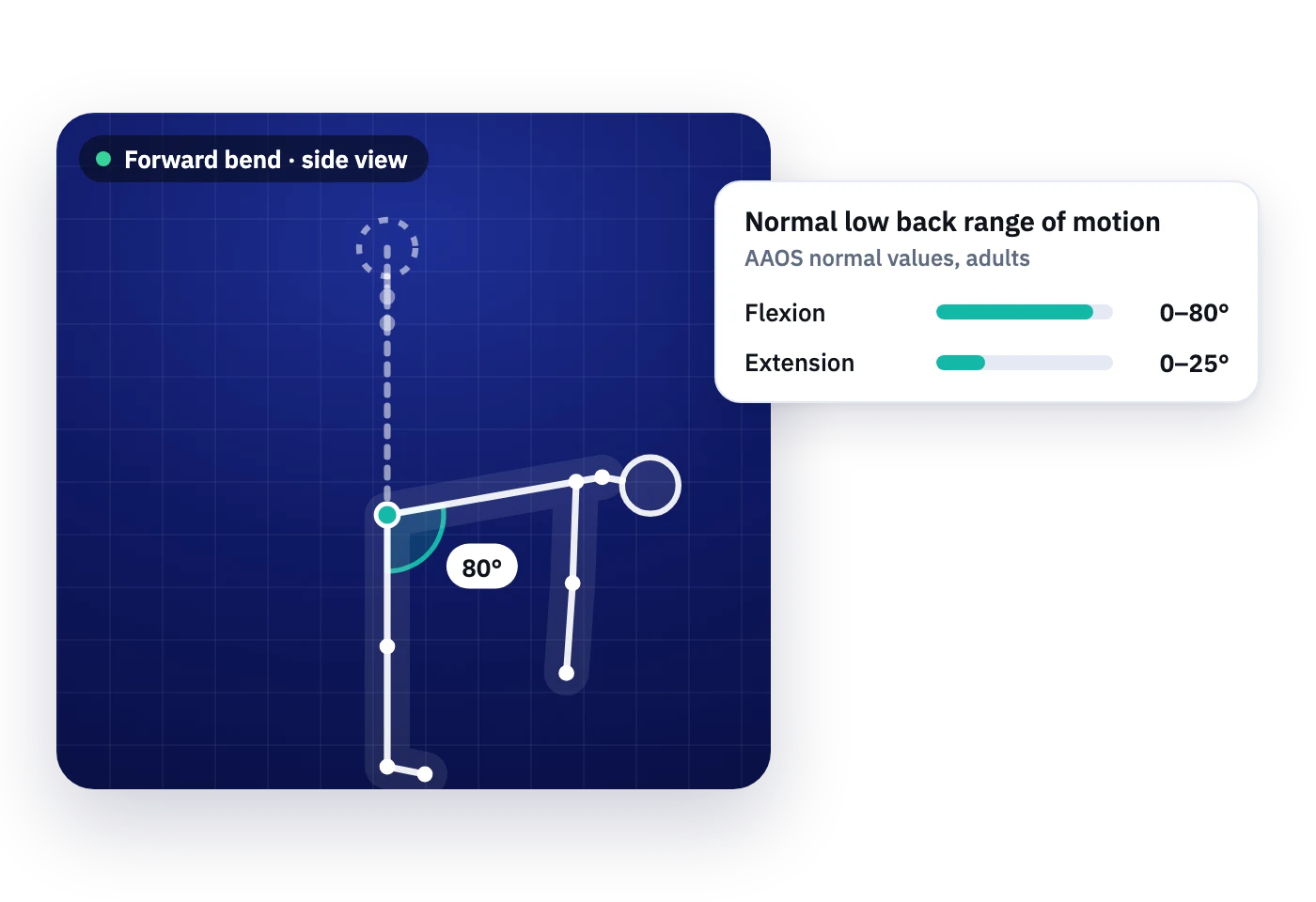
Low back range of motion is measured differently from limb joints. The hips do much of the work in a forward bend, so most methods measure the spine itself with a tape measure or inclinometers rather than a single goniometer angle.
Normal low back range of motion
AAOS reference values describe thoracolumbar motion measured as a whole. References disagree widely for side bending and rotation, so we don't list a single figure for those.
| Motion | AAOS |
|---|---|
| Flexion Thoracolumbar, measured as a whole | 0–80° |
| Extension | 0–25° |
| Lateral flexion References disagree | Varies |
| Rotation References disagree | Varies |
How to measure low back range of motion
The common clinical methods. All start standing, feet apart, knees straight.
Flexion and extension (dual inclinometer)
- Position
- Standing, feet apart, knees straight
- Axis
- Inclinometers over the T12 and S1 spinous processes
- Stationary arm
- Zero both inclinometers in upright standing
- Moving arm
- Lumbar motion is the T12 reading minus the S1 reading
- Watch for
- Knee bending and incomplete return to upright
Flexion (modified Schober)
- Position
- Standing
- Axis
- Mark the midpoint between the posterior superior iliac spines
- Stationary arm
- Mark 10 cm above and 5 cm below it
- Moving arm
- Measure the distance between the outer marks at full forward bend
- Watch for
- The marks drifting with the skin and the knees bending
Lateral flexion (goniometer)
- Position
- Standing, arms at the sides
- Axis
- Spinous process of S1
- Stationary arm
- Perpendicular to the floor
- Moving arm
- Toward the spinous process of C7
- Watch for
- Pelvic tilt and knee bending
Measuring low back range of motion with a camera
From the side, a camera shows the overall forward and backward bend, and how much of it comes from the hips versus the spine. From behind, it shows side bending symmetry. Rotation is hard to see with one camera.
- From a photo: the free online goniometer lets you tap the axis and both segments on a picture and read the angle. Nothing is uploaded.
- Live: MotionArc tracks the joints from any phone, tablet or laptop camera and measures the movement as it happens, in the clinic or on a video call.
Why two clinicians get different numbers
A goniometer reading depends on the person holding it. Finding the bony landmarks, lining up the arms and positioning the patient all add variation, and that variation is larger between two clinicians than for one clinician measuring twice.
- Small changes between two clinicians may not be real. At the shoulder, a true change measured by two different therapists needs about 15°, compared with 6° to 11° when the same therapist measures both times. Agreement between testers is weakest for shoulder extension and internal rotation.
- The instrument matters. At the knee, the smallest difference you can trust is about 6° with an inclinometer, 10° with a long-arm goniometer, 12° with a smartphone app and 14° with a short-arm goniometer or a visual estimate.
- Video can work. Shoulder angles measured over a video call with an on-screen protractor came within 0.2° to 5° of goniometer readings on average, and most smartphone apps studied show adequate reliability.
- What helps: a written protocol for patient position and landmarks, the same instrument each time, the same clinician where possible, and a note of how the measurement was taken.
Measuring from a camera takes out the hand-held step. Nobody has to line up the goniometer arms by hand, and the same view can be set up visit after visit.
Early access is limited, and we set up every account personally.
More reference values: normal range of motion chart for every joint. Other joints: Shoulder · Hip · Knee · Ankle · Neck.
Sources
- American Academy of Orthopaedic Surgeons. Joint Motion: Method of Measuring and Recording. Chicago: AAOS; 1965.
- AAOS values as tabulated in a Jones & Bartlett Learning clinical handbook, chapter 1 (sample chapter). Link
- Norkin CC, White DJ. Measurement of Joint Motion: A Guide to Goniometry. 5th ed. Philadelphia: F.A. Davis; 2016.
- University of West Alabama Athletic Training. Goniometry lab: joint measurement procedures. Link
- Williams R, et al. Reliability of the modified-modified Schöber and double inclinometer methods for measuring lumbar flexion and extension. Phys Ther. 1993. Link
- Mullaney MJ, et al. Physiother Theory Pract. 2010;26:327 (reliability of shoulder range of motion measurement). Link
- Riddle DL, Rothstein JM, Lamb RL. Goniometric reliability in a clinical setting: shoulder measurements. Phys Ther. 1987;67:668. Link
- Hancock GE, et al. J Exp Orthop. 2018 (reliability of knee range of motion measurement methods). Link
- Sahu et al. J Shoulder Elbow Surg. 2022;31:201 (shoulder range of motion by video conference versus goniometer). Link
- Keogh JWL, et al. Reliability and validity of clinically accessible smartphone applications to measure joint range of motion: a systematic review. PLOS ONE. 2019;14:e0215806. Link
Measure trunk movement from any camera.
No goniometer, no wearables. The same movement, measured the same way, every visit.

Low back range of motion questions
Straight answers. If yours is not here, request access and ask us anything.
AAOS reference values for the thoracolumbar spine are about 80° of flexion and 25° of extension. References disagree widely for side bending and rotation, and every method gives different numbers, so compare a patient with their own baseline using one method.
Most often with dual inclinometers at T12 and S1, or a Schober-type test with a tape measure. Both isolate the spine from the hips, unlike measuring the overall forward bend.
A forward bend combines hip flexion and spinal flexion, and people split it differently. Someone with tight hamstrings bends more from the spine. Measure the spine directly if that is what you need.
Yes. MotionArc measures range of motion, form and balance from any phone, tablet or laptop camera, in the clinic or live on a video call. Early access is open to a small group of professionals.
Clinicians sign a business associate agreement (BAA) with us before any real patient data is entered. The free goniometer on this site runs in your browser and never uploads photos.
Request early access
Tell us a bit about your work. We review every request personally and set you up ourselves.